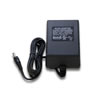
Money Saving Transformer Options
We have had great success with a 16V AC/4.5 Amp transformer
available from:
MCI Transformers: P/N 4-06-8016 16V AC/ 6.25 Amps $19.95
from MCI Trans. Call them at 1-(800) MCI TRAN. (For this
price, you will have to wire it up yourself and you should
use a 1 amp primary fuse & 5 amp secondary breaker).
Most Digitrax authorized dealers have various transformers
available to serve your needs. Contact your favorite dealer
and find out what is available.
Many dealers offer transformer kits made by one of the
following companies (These are build it yourself kits that
come with everything you need including instructions.)
The PT- 6-2 includes a UL-listed transformer, Power cord,
Fuse Holders, 1.5 amp fast-blow fuse, 5.0 amp fast-blow
fuse, shrink tubing, output cable, complete instructions.
Input 110V. Output 16V 6.25 amps. Part number PT-6 $35.00
MSRP. Order from your dealer or direct from Springhaven
Shops (703) 327-6769.
General DCC Transformer Information
There are many transformers and power packs that can supply
the input power for Digitrax boosters & command stations.
Most regular DC train control packs do not have enough power
to supply the full power potential of the a 5 or 8 amp booster,
since they were designed to only run 1 locomotive in a blocked
system. To get the full power potential you may hook up
a suitable alternative transformer. Check with your local
Digitrax dealer to see which transformers he has available.
Be very careful when you hook up your transformer to
be sure that you do not create a shock or fire hazard.
Many modelers have safely hooked up line transformers when
creating their own conventional DC throttles, from one of
the many "do it yourself" project articles. If
you are not comfortable with the 110Volt input wiring, we
strongly suggest you consult with an electrician.
1) Most important is to be sure the 110V input voltage
is safely isolated from the low voltage secondary of the
transformer. A properly installed safety ground will ensure
that the layout cannot become a shock hazard if there is
mis-wiring or insulation failure.
2) You must protect the primary and secondary windings
of the transformer from overload. A typical primary protection
would be a 1 amp "slow-blow" fuse (in an appropriate
fuse holder) wired in the primary line circuit. For the
secondary we recommend a circuit breaker rated no larger
than the minimum of either the transformer secondary current
rating or the booster's output current rating (typically
5 or 8 amps).
|